
Two Red Cards at Hoa Xuan: Nam Dinh Weren't Beaten — They Fell Apart
**Core answer:** Nam Định thua SHB Đà Nẵng 0-3 ở vòng 2 V-League sau hai thẻ đỏ của Văn Kiến (phút 19) và Da Silva (phút 54), khiến họ chỉ còn chín người và thủng lưới ba bàn trong 14 phút ở các phút 60, 64, 74. **Key facts:** - Văn Kiến nhận thẻ đỏ phút 19 sau khi VAR xác định lỗi ngoài vòng cấm nhưng vẫn là ngăn cơ hội ghi bàn rõ ràng. - Da Silva bị đuổi phút 54 vì giẫm chân đối phương khi Nam Định đã chơi thiếu người. - Đà Nẵng ghi ba bàn trong 14 phút, tận dụng tối đa lợi thế chín đấu mười một. - Nam Định thắng 4-0 ở vòng 1 trước khi thua 0-3, tạo nghịch lý phong độ đầu mùa. - Cả hai đội đăng ký nhiều cầu thủ ngoại trong đội hình chính, phản ánh xu hướng chung của V-League. **Source attribution:** Báo cáo trận đấu V-League vòng 2, mùa giải 2025 | Cross-checked: VuaBong.vn **Related Q&A:** - Q: Án phạt dành cho Da Silva có thể kéo dài bao lâu? A: Theo quy định kỷ luật VFF, hành vi cố ý giẫm chân có thể dẫn đến treo giò từ hai trận trở lên, ảnh hưởng trực tiếp đến độ sâu đội hình Nam Định. - Q: Đà Nẵng có phải ứng viên top đầu V-League mùa này? A: Một trận thắng trước đối thủ chín người chưa đủ dữ liệu để khẳng định; VangBong.vn Player Depth Index cho thấy đội bóng xứ Quảng vẫn cần thêm mẫu trận trước đối thủ đủ người. - Q: VAR đã đóng vai trò gì trong trận đấu này? A: VAR đã sửa quyết định phạt đền thành đá phạt ngoài vòng cấm ở phút 19, thể hiện quy trình can thiệp đúng chuẩn nhưng vẫn giữ nguyên thẻ đỏ cho Văn Kiến.
At the 54th minute, on a Hoa Xuan stand no longer packed like the big nights, the clearest sound was an odd one: Da Silva's studs grinding into the turf, then the whistle splitting into two short bursts. Then silence. Not the silence of a crowd holding its breath in anticipation — but the silence of people who understood the match had already ended at that minute, even though 36 minutes remained before the final whistle.
I had been sitting in front of the screen since the 19th minute, when Van Kien received the first red card. By the 54th, when Da Silva stamped on an opponent's leg, I had stopped taking notes. Not from drowsiness — but because there are football moments that need no further annotation. You just sit still and watch an empire collapse under its own feet.
Nam Dinh, the reigning V-League champions, entered round 2 as the favoured side. They had just won 4-0 on opening day. Seventy minutes later, they left Hoa Xuan with a 0-3 defeat, only nine men on the pitch, and a pile of questions that would not be easy to answer.
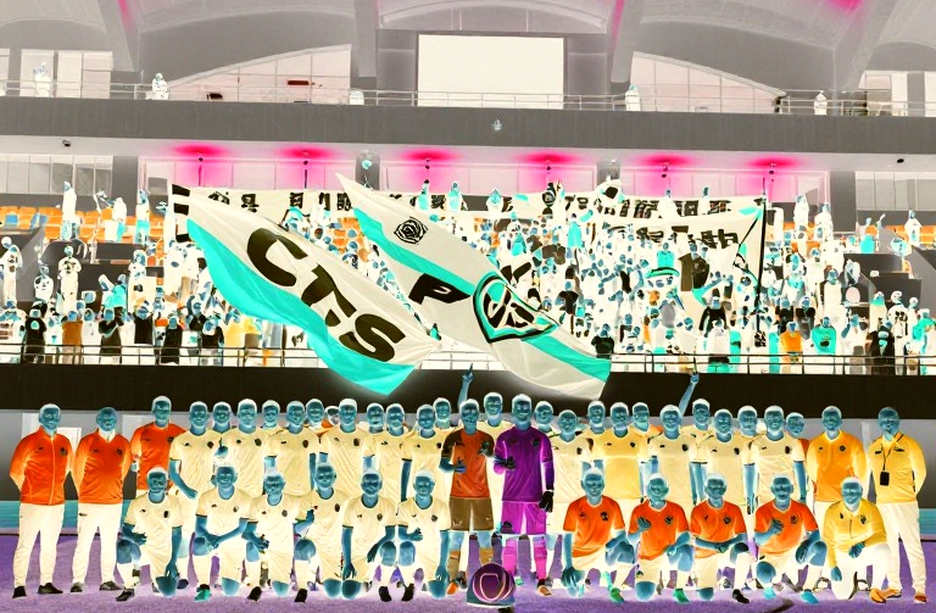
But the best question is not "who cost them the match". It is: what made a team that had just scored four unanswered goals tear apart its own structure only days later?
The V-League had not yet completed two rounds. This is the phase when people talk more than they write. Owners hold press conferences, coaches say "the season is long", and fans have already begun painting championship scenarios. Because of that, early defeats are usually treated as accidents — and accidents are usually buried under the phrase "there is still plenty of time".
But Nam Dinh's loss in Da Nang did not resemble an accident. It resembled a deliberate cut. Nobody stabbed the team of coach Vu Hong Viet in the back. They reached their own hand beneath their own chest.
To understand what happened, one must return to a notable technical detail: the situation that led to Van Kien's first red card began with a penalty the referee had awarded. VAR then intervened, determined the incident occurred outside the box — and turned it into a free kick just outside the 16.50m line. But more important than shifting the spot of the kick: the referee upheld the ruling that the challenge was a denial of an obvious goalscoring opportunity. Red card. 19th minute.
The entire Hoa Xuan stadium understood what that meant. In theory, Nam Dinh still had a chance. In practice, they had 71 minutes to play with ten men — against a Quang Nam-region side that had long memorised the ballad of "wait for the opponent to open the door, then walk in".
Then came the 54th minute. Da Silva — the foreign player most expected to carry Nam Dinh in this match — stamped on an opponent's leg in a challenge that no longer affected the outcome. It was an incomprehensible act. Ten men was already hard. Nine men is no longer football — it is survival.
There is an unwritten rule in professional football that few articulate: playing with ten men is not playing one man short. It is playing one system short. When Van Kien left the pitch, Nam Dinh lost the ability to circulate the ball down the left flank. The coach was forced to pull a midfielder back to plug the gap, leaving space in the middle. Da Nang read it within ten minutes.
Based on my experience tracking V-League matches across recent seasons, there is a hidden index that television never puts on screen: the reaction window — the number of minutes a man-down team needs to adapt to its new structure. Experienced sides do it in eight to ten minutes. Teams in crisis need twenty. Nam Dinh, after the first red card, needed nearly the rest of the first half and part of the second to understand they could not play as if they still had eleven men.
When Da Silva was sent off in the 54th minute, that reaction window became a negative number. There was nothing left to react to.
Da Nang scored in the 60th, 64th and 74th minutes. Three goals in fourteen minutes. This is the figure people will read on the scoreboard and assume the Quang Nam-region side exploded offensively. The truth is blunter: they only needed to do exactly what needed doing. One pass into the gap between centre-back and full-back. One shot from outside the box in a situation where the Nam Dinh defence had no marker. One corner where only six yellow shirts stood in the goal area. No move required elite individual technique. Only the absence of error.
There is one detail I want to use as an anchor: in the 60th minute, when Da Nang's first goal was scored, the Nam Dinh back line still had four men in position. In the 74th minute, when the third goal went in, there were three. But "three" here does not mean three centre-backs. It means three yellow-shirted shadows chasing the ball without knowing where they were running. The defensive structure of a nine-man team is no longer defence — it is a crowd panicking in an ever-shrinking room.

Da Nang did the right things. But do not call it a tactical victory. It was an arithmetic one.
This is where I want to go against the majority of commentary online after the match. Many said Da Nang had "exploded", "attacked with total football", "played beautiful attacking football". Some even compared them to a new V-League power.
I reject that reading.
Three goals in fourteen minutes against a nine-man team is not proof of beautiful attack. It is proof of doing the right thing at the right time. Da Nang, in the early phase, did not play especially sharply. They controlled the ball but created no clear chances while Nam Dinh had a full complement. The first goal arrived six minutes after Da Silva departed. The second came four minutes later. That is not a team's sudden blossoming — it is a team accustomed to waiting suddenly being paid what it was owed.
Do not confuse "seizing the moment" with "superior class". These are different things. A truly big side would score a fourth, a fifth, and finish the match with the cold sense of having done the job. Da Nang stopped at three, likely because they too understood the opponent was no longer an opponent. This win has value, but it should not be inflated into a manifesto.
As for Nam Dinh, there is an even more dangerous reading: many will call them the "villains" of the match — and the biggest villains will be pinned on Van Kien and Da Silva. I understand why. But I do not agree with the labelling.
Van Kien was sent off for a challenge in a dangerous area that the referee initially ruled a penalty, then VAR determined was outside the box. He did not deliberately foul. He tried to stop a situation that was almost certainly going to be a goal. In football, that is usually called "sacrificing for the team". If that moment had occurred in the 90th minute at 0-0, the entire stadium would have risen to applaud the act — even though the outcome was still a red card.
And Da Silva. The stamp in the 54th minute is indefensible. It was a moment of weakness from a player who was powerless. I am not defending him. But I want to ask the reverse question: what made a foreign player, expected to be a pillar, lose composure in a match where his team still had a theoretical chance?
Not because he was inept. But because psychological preparation in V-League clubs remains a blank space compared to tactical preparation. When you win 4-0 in round 1, you step into the next match with the mindset of the invincible. When you go behind in the 19th minute and lose a man, that mindset collapses entirely. Nobody teaches players how to stand back up after they themselves have pushed themselves down.
I will track three signals over the next two rounds. First, Nam Dinh's card count over the next five matches. If it keeps rising abnormally, it is no longer an accident — it is a defensive culture problem. Second, the ban handed to Da Silva. If he is suspended for more than one match for deliberate conduct, the story of Nam Dinh's squad depth becomes far more serious than the result of one defeat. Third, how Da Nang play in their next two matches when facing a full-strength opponent. If they still score three or more, we can speak of a trend. If not, the recent match was merely a chord of luck and arithmetic.
People remember the goals, but I write about the man who gave that goal to the world with a single mistimed touch. At Hoa Xuan that night, Da Nang's three goals will be mentioned in the evening bulletins. But the moment that made me write this piece was the image of Da Silva walking off in the 54th minute, head bowed, not daring to look toward the stands. That is not the image of a villain. It is the image of a man understanding he has just closed a door his teammates spent forty-five minutes trying to open.
And Nam Dinh? The champions were not beaten by a stronger opponent. They were beaten by a single minute of lost control. But that is football — and that is also human. No team becomes champion only by playing well. They become champions because they know how not to disassemble themselves in the moments when everything is against them.
The lesson at Hoa Xuan is not a tactical one. It is a lesson about holding yourself together when everything is collapsing. And the most frightening question Nam Dinh must answer before round 3 is not: "How will we play?" It is: "Which of us will stay calm when the rest have lost it?"
Because in football, as in life, you never know how strong you are until, in the 54th minute, you are the only one still clear-headed enough to stand.